So You've Got Your Human Design Chart. Now What?
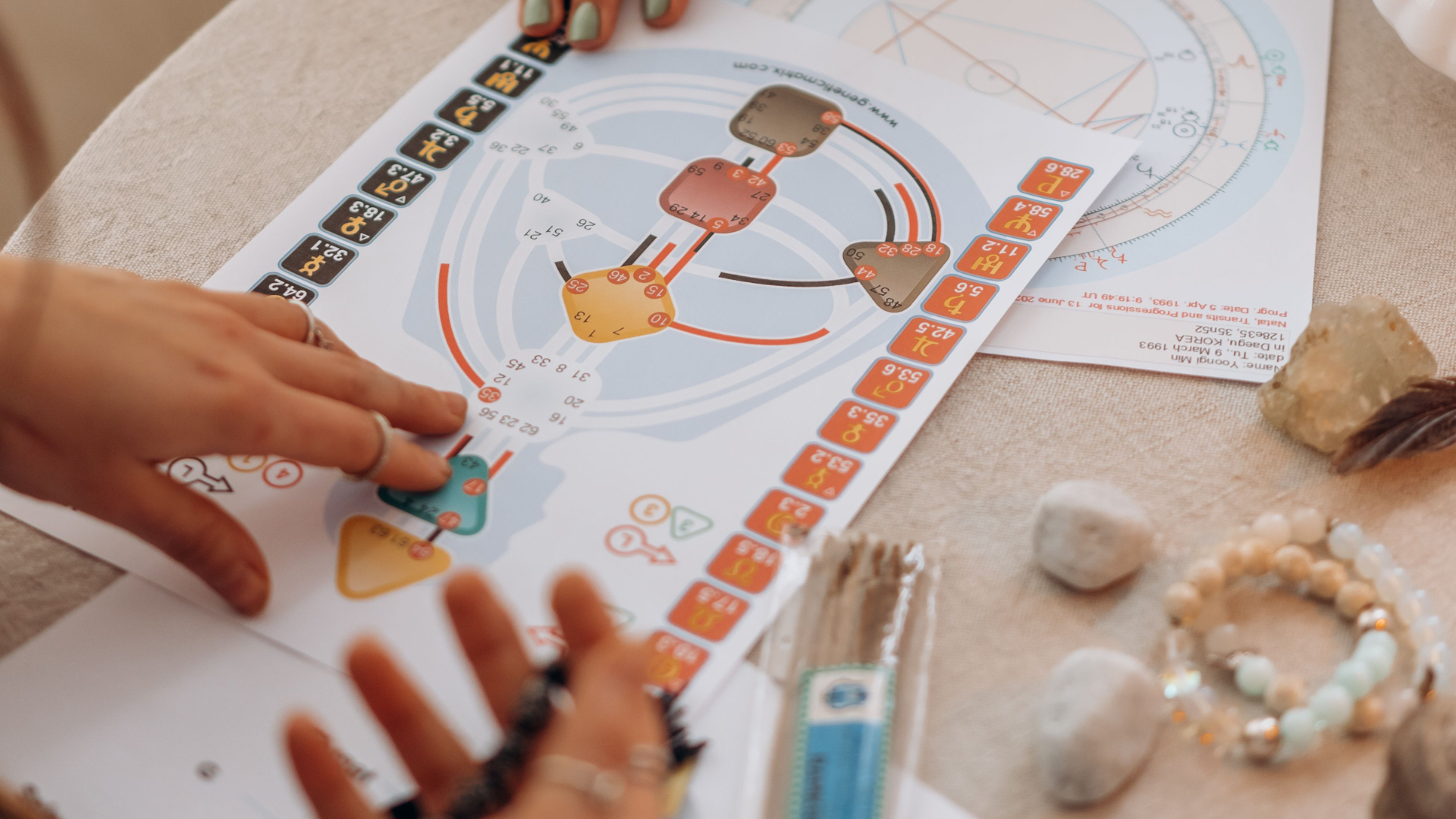
You've got the PDF. Maybe a free human design chart from a generator, maybe a reading from a practitioner, maybe a friend sent you a link at 11pm and you fell down a rabbit hole. Either way, you're now looking at a wheel covered in coloured shapes, a list of numbers that mean nothing to you yet, and a type label you may or may not recognise.
So… Now what?
This is the moment most people quietly close the tab. Not because a human design chart isn't useful, but because the first encounter with one is almost designed to overwhelm you. Sixty four gates, nine centres, four types, twelve profiles, a cross, an authority, a strategy, definitions, channels, lines. Nobody hands you a glossary first. You just get the wheel and a string of words that sound like they're from a different language, because in a sense, they are.
So before we go anywhere near what to do with this information, let's talk about what your human design chart actually is, because that changes everything about how you use it.
Your human design chart isn't a personality quiz result
If you've done any kind of typing system before (Myers-Briggs, Enneagram, even astrology to a point) you've probably learned to read a result and go "yes, that's me" or "no, that's not me at all." A human design chart doesn't work like that, and treating it like it does is where most people get stuck early on.
Your chart isn't describing your personality. It's describing your energetic design, the way your body is built to operate, make decisions, and use energy. Some of what it tells you will feel instantly true. Some of it will feel like a description of someone you don't recognise, often because you've spent years operating against your design rather than with it, and the conditioning has become so familiar it feels like "just who you are."
That's LITERALLY the whole point of looking at it.
So if you read your type and felt an odd mix of recognition and resistance, that's normal. You're not doing it wrong. You're just meeting a more accurate map of yourself than the one you've been using, and accurate maps don't always match the territory you thought you were standing on.
Start with type, and only type
The temptation with a new human design chart is to try to absorb everything at once. Resist that. There is so much information packed into a chart that trying to integrate all of it in week one is a fast route to giving up entirely.
Start with your type. It's the single most load-bearing piece of information in the whole chart, because it tells you how your energy is built to move through the world.
There are five types, and they break down roughly like this:
Generators and Manifesting Generators have a defined Sacral centre, which means a steady, renewable life force energy that's meant to respond to life rather than initiate it from a standing start. If you're a Generator, your work is learning to follow what genuinely lights you up (your "sacral yes") rather than what you think you should want.
Projectors don't have that sustained Sacral energy. They're built to guide, advise, and see others with real clarity, but they're not designed to work at the same relentless pace as a Generator. Rest isn't optional for a Projector. It's structural.
Manifestors are initiators. They're built to start things and move independently, but without the sustained energy of a Sacral centre to keep pushing through, so they need rhythms of action and recovery rather than constant output.
Reflectors are rare and entirely different again. They have no defined centres at all, which means they're deeply sensitive to their environment and people around them, and they need significantly more time than any other type to know what's true for them.
If none of that fully lands yet, that's fine. The point right now isn't mastery. It's recognition. You're looking for the type description that makes you exhale a little, the one that explains a pattern you've spent years either fighting or apologising for. If you want to go deeper on any of the five types, Jovian Archive's beginner hub is a solid foundational resource, since it's the official archive of the system's original teachings.
Then look at strategy and authority together
Once type feels reasonably settled, the next layer is strategy and authority, because together they answer the question that actually matters day to day: how do I make decisions that are right for me?
Strategy is the "how" of engaging with life based on your type. A Generator's strategy is to respond rather than initiate. A Projector's is to wait for recognition and invitation before stepping in. These aren't rules imposed from outside. They're descriptions of how your energy already works best, whether you've been honouring that or not.
Authority is the "where" of decision making, the part of your body that holds the most reliable truth for you, faster than your mind can rationalise it. Emotional authority means your truth arrives over time, through the wave of an emotional process, not in the heat of the moment. Sacral authority is an immediate, gut-level yes or no, felt before the mind catches up. Splenic authority speaks once, quietly, in the moment, and doesn't repeat itself. There are others too, each with their own rhythm.
This is usually where people have their first real "oh" moment. If you've spent years feeling like you make terrible decisions under pressure, or like your gut never seems to know anything, or like you need way more time to decide things than everyone around you seems to need, your authority might be the first real explanation you've had for why that's not a character flaw. It's design.
Reading the open centres on your human design chart without trying to fix them
Here's where a lot of people get into trouble with their chart, often without realising it. Open or undefined centres are coloured white on your human design chart rather than filled in, and they represent places where your energy isn't fixed, it's fluid. You take in and amplify whatever's around you in that area of life rather than running your own consistent theme there.
The trap is treating open centres like deficiencies that need fixing. They're not. An open centre is actually a place of wisdom, eventually, once you understand it. It's where you're built to learn about that part of life by experiencing it in other people rather than generating it yourself from a fixed identity.
The risk with open centres isn't the openness itself. It's not knowing it's open, and unconsciously absorbing other people's energy, beliefs, or emotions there and mistaking them for your own. An open Solar Plexus, for instance, can mean you feel everyone else's emotional weather as if it were yours. Once you know that's what's happening, you get to ask "is this actually mine?" instead of just drowning in it.
You don't need to understand every open centre in depth right now. Just knowing they exist, and that they work differently from your defined centres, is enough for this stage.
Let go of the idea that you'll "master" this quickly
This is probably the most important thing to hear early on, and the thing almost nobody tells you when you're new: Human Design isn't something you learn once and then know. It's something you live into, slowly, over years, in layers.
People who've worked with their chart for a decade are still discovering new dimensions of it. That's not a sign the system is too complicated to bother with. It's a sign of how much is actually there, and how much conditioning most of us are unlearning at the same time as we're learning the design underneath it.
So give yourself permission to take this slowly. Read your type description again next week. Sit with your authority for a month before trying to apply it to every decision. Notice one open centre in action before you go hunting for the next one. The chart isn't going anywhere, and neither is the part of you it's describing.
Where to go from here
If you want the practical next step, the things to actually do with this information now that you've got a basic handle on what your human design chart is saying, that's exactly what the next piece in this series covers. Think of this one as the orientation, and the next one as the action plan.
But if all you take from this piece is one thing, let it be this: your chart isn't a verdict and it isn't a costume. It's closer to a mirror that's slightly more accurate than the one you've been using. Some of what it shows you will feel like coming home. Some of it will take longer. Both are part of the same process.
You don't need to have it figured out today. You just need to start paying attention. And if you haven't generated your chart yet, or want to double-check the one you've got, you can run your details through our free human design chart calculator any time.